‘Our Flag Means Death’: a review

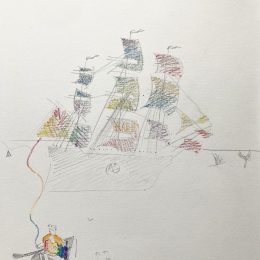
It’s Pride month! Arguably the best month of the year, and we say that being completely unbiased. As GCSE students, we have plenty of time to procrastinate and watch TV instead of doing work and, oh boy, has ‘Our Flag Means Death’ (OFMD) been good way to do that. For those of you unfamiliar with the show, it’s a romantic comedy set during the Golden Age of Piracy (read: 1650s-1730s), which follows the Gentleman Pirate, Stede Bonnet (played by Rhys Darby) and famed pirate Blackbeard (Taika Waititi). Similarly to Heartstopper, a Netflix series that has also become immensely popular over the last few weeks, OFMD has queer characters and storylines at its centre – something which the majority of mainstream modern media lacks.
‘Our Flag Means Death’: a review

‘The Color Purple’ by Alice Walker – A Brief Discussion

‘The Color Purple’ is one of the most captivating books I have read in a long time, and I would thoroughly recommend it to anyone. It’s an epistolary novel published in 1982, partly based on a true story Walker’s sister told her about a love triangle her grandfather was involved in. The novel itself is set in rural Georgia from 1909-1949, in which we observe Celie growing up through her letters to God. The letters are craftily written, with an authentic feel from Celie (who isn’t largely educated), as we see from the grammatical and spelling mistakes throughout, adding to the realism of her situation. Her struggles, especially around being an African American woman in this time period, and in the Deep South, are voiced extremely well on Walker’s part. Although a fictional account on life, I feel it’s really valuable for understanding hardships and prejudices which may have been experienced here. Before I elaborate on the novel, an interesting fact is that it was banned in American School libraries from 1984-2013.

‘The Color Purple’ by Alice Walker – A Brief Discussion

Why We Haven’t Found a Cure for Cancer Yet

We have found ways to edit genetic material, cloned sheep, and mapped the entirety of the human genome. But there is one single anomaly completely unphased by the billions of dollars invested in decades of research and still upholds its position as one of the leading causes of death around the globe. What is it about this fascinating phenomenon that makes it so hard to eradicate cancer?

Why We Haven’t Found a Cure for Cancer Yet

Dead Actors in Film

What do the Last Jedi, Fast and Furious 7 and a Galaxy chocolate commercial all have in common? They all star dead actors. In the Last Jedi, CGI was used to alter footage of Carrie Fisher, to give Princess Leia a second life on screen. In Fast and Furious 7 Paul Walker, recently deceased, was deep faked into scenes to allow the character one final send off. And in 2014, a Galaxy Chocolate commercial had a twenty second shot of Audrey Hepburn to promote their produce, even though the actress has been dead for twenty years. Although in these scenes the ‘ghost actors’ have minimal roles, they are paving the way for something more; as ‘deep-fake’ technology increases, could it be possible for dead actors not just to appear, but also to star in films?

Dead Actors in Film

Are The Classics Redundant?

Most scholars would describe the first stanza of Sappho 31 as a confession of love, from a woman to another, describing the anxieties of attraction. More and more I hear people discussing whether the Classics, be it Greek or Latin, should still be included in the curriculum. And yet the question of whether the Classics are redundant baffles me, when this singular poem could so easily be studied in English, History, or the Classics, and it discusses topics that are still crucial in our ever-changing world today – what is love, what it is to love and what it means to be queer.

Are The Classics Redundant?