Comparing Dido and Cleopatra

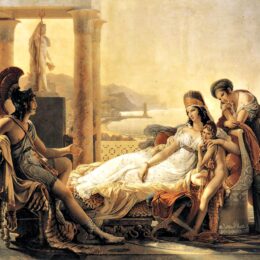
Virgil’s epic, ‘The Aeneid’, tells the story of Aeneas; the dutiful Trojan hero who (after several sorrowful episodes) founds the city of Rome. It makes sense, therefore, that Virgil, writing under the first Roman emperor Augustus, creates links between the characters of his foundation myth and the powerful figures of ancient Rome which his readers inhabit.

Comparing Dido and Cleopatra

Christmas Dinner: An (Un)Official Ranking

As we’re twenty-five days away from the big day, I’ve been thinking about the most treasured parts of the holiday – the secret Santa debacles, the competitive gingerbread baking, and the Christmas dinner controversial opinions (as is expected when raised by a cooking-obsessed Dad, who wakes up at 7:00 on Christmas day to start prepping brussels sprouts, I’ve got quite a few strong thoughts). So, in honour of Christmas rapidly approaching, I gathered a group of my friends and asked (forced) them to rank parts of Christmas dinner out of ten. Here’s the official list!

Christmas Dinner: An (Un)Official Ranking

The Hunger Games: The Ballad of Songbirds and Snakes Film: A Review

Full disclosure – I write this review as a huge Hunger Games fan. In fact, when I heard a film was being made of the Hunger Games prequel, my Year 8 self practically exploded with excitement. Another disclosure – I am forever and always ‘The Books were better’ – I shall try and refrain from using this exact phrase repeatedly throughout the course of this review, but truthfully, I doubt I will manage more than a sentence.

The Hunger Games: The Ballad of Songbirds and Snakes Film: A Review

China’s Population Demographics: Winners and Losers

Until recently, China was the world’s most populous country with around 1.4 billion people, equivalent to a staggering 17.72% of the total world population. Yet, an irreversible population decline in China has led to India overtaking it as the world’s most populous country. Reasons for this mainly centre around the transition of China’s traditional centrally planned economy to a mixed economy, allowing for greater freedom from the state in many industries. This has allowed for China to become an internationally competitive country, with employment opportunities for men and women that has resulted in households no longer feeling obligated to have children. In fact, between 2019 and 2021, large Chinese provinces and cities have seen huge drops in birth rates, largely due to China’s economic boom. China’s urbanisation has also shown a change of view in a woman’s “purpose” and “role” in the household, particularly in rural areas. Chinese traditions that were once focussed on women being responsible for all domestic duties and having children, rather than aspiring to obtain a future career, have given way to greater emphasis on gender equality, especially in education. These progressive values have encouraged women to work rather than settling down and is leading to a view that marriage and birth are barriers to freedom.

China’s Population Demographics: Winners and Losers