

Continuing our series on inspiring Wimbledon Alumnae, this week we journey from the spheres of politics and film to academia and activism with the story of Dinah Hutchinson, honouring her extraordinary legacy as one of the pioneering women to study at New Hall, Cambridge, following her recent passing at 90 years old. Read on to discover how this courageous and trailblazing alumna sought knowledge and opportunity at a time when women faced countless barriers and, in doing so, built a legacy of achievement and resilience.
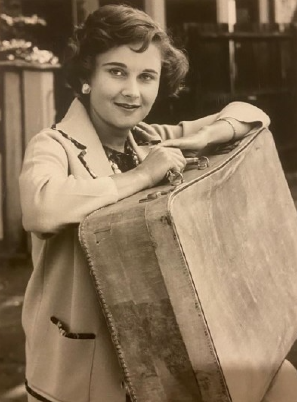
Dinah Hutchinson was born Dinah Gillian Jenepher Martyn Burford in 1935 in Wimbledon, to father, Leon, a confectioner who would become a director of Cadbury’s, and mother, Joan, who ran a pre-preparatory school from their family home, once the Bishop of Southwark’s house in Wimbledon. Following the Second World War, Dinah passed the 11-plus exam to attend Wimbledon High School and studied here before applying to Cambridge in 1953.
In her first year at Cambridge, a new women’s college, New Hall, now renamed Murray Edwards College, was founded and Dinah was among the first cohort of 16 women to study history there, making her one of the first women to receive a degree from the college. The college had only two tutors during her time there and was ridiculed by a male speaker at the Cambridge Union as “that new boarding house in Silver Street with leftover luggage lying around outside.” In a speech, she responded, “I stand here before you part of the leftover luggage.” Notably, Cambridge was the last major UK university to grant women full membership and the ability to receive degrees from the institution in 1948.
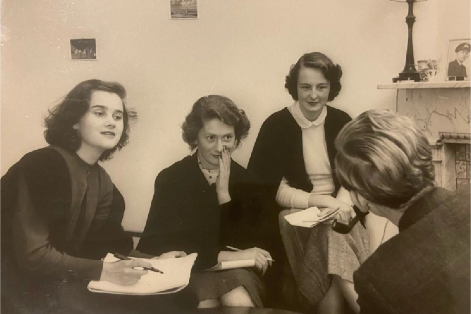
In her 2nd year at Cambridge, Dinah was a member of a cohort eager to establish a Cambridge University Women’s Unionsince, until then, the Cambridge Union had voted to exclude women. Their efforts were successful, and Dinah went on to become the second President of the Cambridge University Women’s Union. During her time as President, she was approached by an elderly male Cambridge resident who had read an article about the Union in the press and was prepared to leave an equivalent of £3.3 million in today’s money in his will for the Union. It was only in 1963 that the Cambridge Union Society finally voted to allow women in.
Following her successful years at Cambridge, Dinah read for the Bar Exam at Gray’s Inn, a historic society educating and training barristers here in London. During this time, she supported herself financially by working as a market research and statistical executive. Her academic pursuits had not ceased, though, as she won a Rotary International scholarship to study international relations at Harvard. Following her return to Britain, she joined an advertising company as marketing executive where she met her husband, Piers Hutchinson, the son of novelist RC Hutchinson, known as a writer of King George VI’sspeeches. The couple had 4 children together. During their marriage, Dinah passed the Finals of the Bar exam while eight and a half months pregnant, though she ended up working in property management: buying, renovating, and leasing houses and flats to work around her family. Her marriage was later dissolved in 1971, when she moved to a house overlooking Regent’s Canal where she remained.
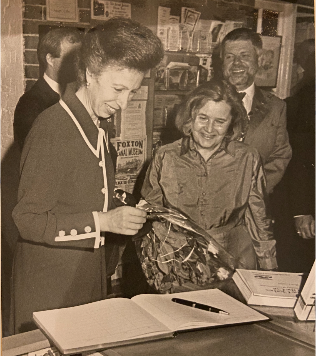
Her Regent’s Canal home featured a view of a waterway running at the bottom of the garden. While living there, Dinah noted that the canal’s towpath had been left to ruin, prompting her to join the Regent’s Canal Group to remedy this. Shebecame the honorary secretary of the group and, by the mid-70s, the path between Little Venice and Limehouse Basin was cleaned up and made accessible to the public, winning the group a Civic Trust Award. This experience pushed her to the idea of establishing a waterways museum. Previously, canal museums had been established across Britain but there were none in London, so Dinah helped to register the Canal Museum Trust and looked for a canal-side building to house the museum. After many difficulties, a 35 year lease was negotiated, a grant from Islington Council was awarded, and seven years’ free rent was promised. Thus, by 1992, the London Canal Museum was officially opened by Princess Anne (at the invitation of Dinah) who remained patron of the museum. This experience led her to pursue a postgrad diploma in museum studies.
Described in her obituary in The Times as resilient, spirited, and intelligent, she serves as a notable reminder of one of the many successful and inspirational women of Wimbledon. Her passion for academia and activism, paired with her unwavering enthusiasm and intellect, continues to inspire our school community and beyond. As we remember her legacy, let us also, as young women, be emboldened to foster resilience, pursue knowledge, and commit ourselves to shaping a more inclusive society, just as Dinah did.
